ESX Framework V3
$100.00
A ready-made server is a whole city sold as one download, not a resource you bolt onto a city you already have. An ESX server or a QBCore server arrives here with its framework, database, jobs, interiors, vehicles, clothing and long tail of small scripts already made to agree with each other.
That agreement is the product. Anyone can install a framework for nothing. What costs money here is somebody having already decided which inventory wins, which target system everything hooks into, whose phone and whose garage the city runs on, and then having fixed everything that decision broke.
None of it arrives finished. Database credentials, a licence key, admin permissions, your server name and your own economy values are still yours to set before anybody can connect. Server packs on this shelf run from $25 to $120.
Assembling a roleplay server from parts is not really a coding job. It is an integration job. The weeks go on reconciling item lists, deciding whether ox_inventory or the framework's own inventory owns weight, discovering that two resources both want to run the garage, and rewriting a job because the phone it expects is not the phone you installed. A build on this shelf has had that argument already and shipped the result.
What you give up is the choosing. Somebody else picked the inventory, the target system, the HUD and the phone, and pulling any one of those out later touches everything that hooks into it. That is a fair trade if you do not yet have opinions about your stack. It is a bad trade if you do.
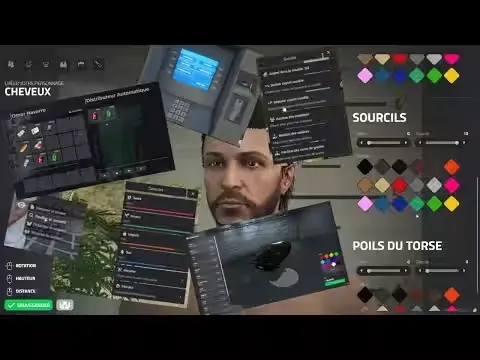
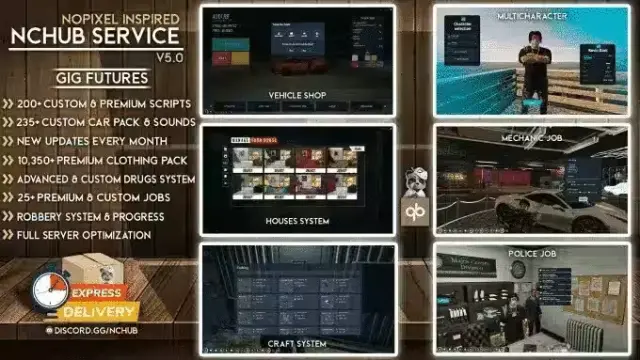
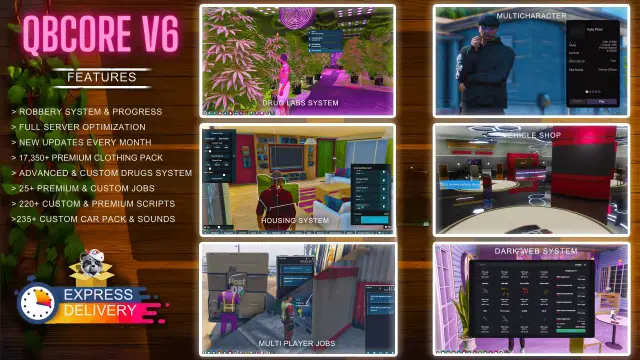
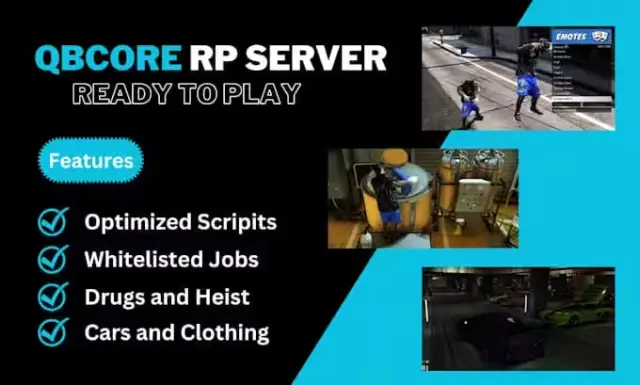
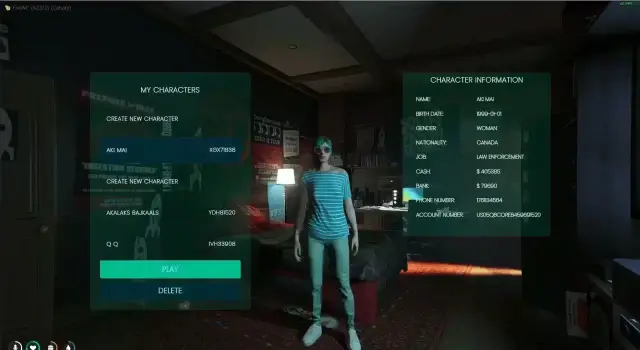
The lists vary between creators, but the spine of a server pack is consistent. Character creation and multicharacter, a spawn selector, a loading screen, banking with cards and transfers, garages and an impound, dealerships for cars and often for boats and aircraft, clothing stores, barbers, tattoo parlours, fuel stations, cash machines, a pawn shop and an ammunation. That is the civilian furniture a city needs before anything else in it means very much.
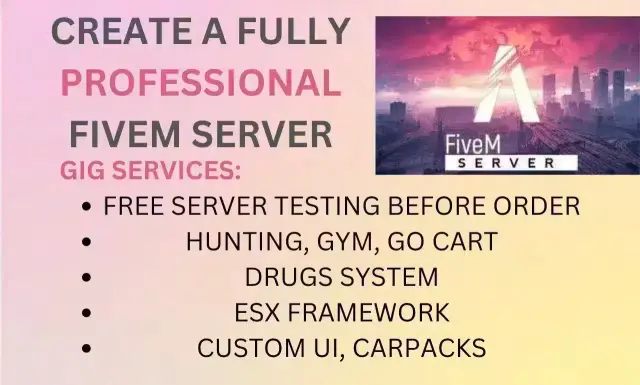
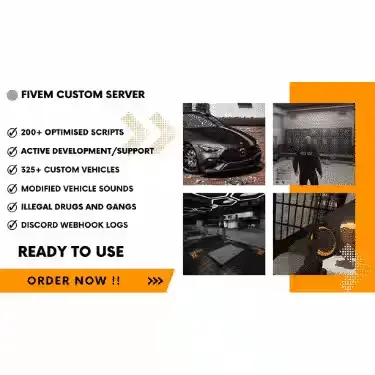
On top of that sit the jobs and the crime. Police and EMS with an MDT between them, taxi work, a mechanic garage, a handful of restaurants, then farming, fishing, hunting and lumberjack loops for players who want something quiet, then the drug chain and the robbery tree that runs from convenience stores up through banks, trains and cargo. Larger builds add a casino and an admin menu. Most of them stream a vehicle pack and a clothing pack of their own, which is where the download size comes from.
Read the listing for what it names rather than what it counts. A build advertising a script count is telling you about weight as much as content, and the useful question is whether the resources it names are ones you would have picked. Watch the showcase video properly before you buy. On this shelf you are buying an aesthetic and an economy, not a feature list, and both of those are visible on screen in a minute.
The shelf splits along the two big frameworks. The QBCore line runs several generations deep, each one a different studio's idea of a complete city, and Qbox builds belong with them because Qbox is a QBCore fork that runs QBCore resources unchanged. The ESX side is smaller and built on es_extended, which is what people mean when they talk about an ESX server. The ESX Legacy build is the one to look at if you want an economy that has been balanced rather than maximised, and the Qbox build is the cheapest way onto this shelf at all.
Choose the framework before you choose the build, because the framework decides what you will be able to buy for the rest of the server's life. Almost every resource in the QBCore, Qbox and ESX shelves declares which of them it supports, and the gap between the two big lists is real. Converting a resource across is an afternoon of work at best. If you have never stood a framework up before, the QBCore installation guide is the version with the steps in it.
A build arrives as server files and a database dump, and nothing in either knows anything about you. Database credentials, your Cfx.re licence key, the server name and description, admin permissions, the whitelist and the starting economy values all have to be set by hand before the first player connects. Keys and tokens belong in convars rather than in server.cfg where anyone with the file can read them, and that is much easier to get right at the start than to unpick later.
Expect the first session to be configuration rather than roleplay. When a resource refuses to start, fxmanifest.lua and load order explain most of it, while the common FiveM errors and QBCore troubleshooting cover the rest. Connection failures are usually the licence key or the port rather than the build. Logging is the one thing worth adding on day one, because Discord webhooks turn an unexplained economy into an audit trail.
A ready-made server is heavier than the framework it is built on, and heavier again than the sum of its scripts once it streams its own vehicles and clothing. That shows up as RAM, as disk, as a longer first download for every player who joins, and as single core pressure while the server ticks. Choosing hosting specs covers what to size for, and the VPS against dedicated against cloud comparison covers where to put it.
Once it runs, measure before you add. A build is full of resources you did not choose, some of which your city will never use, and deleting those is the cheapest performance work available to you. Server FPS and several heavy scripts at once explain what to watch in resmon. A packaged build also ships with somebody else's security posture, so read protecting a server from exploits before you open the doors.
These are different decisions rather than different budgets. Buy a build when you want players in a city this month, when you have no firm opinion yet about inventory or targeting, and when you would rather spend your evenings on rules and roleplay than on integration. Assemble instead when you already know your stack, when you intend the server to still be running in a year, or when the thing that will make your city yours is a set of resources no packaged build contains. Extending a build later is normal either way, and the MLO interiors, job scripts and vehicle packs are where most owners go first.
The free route is worth naming honestly. Every build for sale on this page is paid, and what the price covers is the assembly rather than the framework: QBCore, Qbox and es_extended are open source and cost nothing to download, and plenty of what is on the free shelf will fill the gaps around a bare one. What you pay for on this page is the assembly, the database, the interiors and the content, not the framework underneath. If your budget is mostly your own time, take that route and read the beginner's guide to installing scripts before you start.
Whichever way you go, a build is a snapshot of the day it was packaged. Ask what the creator's update record looks like before you hand over the money, because what lifetime updates actually means varies enormously between studios, and a package that stops being maintained quietly becomes your codebase. The checklist for vetting a script applies to a whole build harder than it applies to any single resource, and escrow against open source decides how much of it you are allowed to repair yourself.
An ESX server is a FiveM server running es_extended, the roleplay framework that gives a player an identity, a wallet, an inventory and a job. The framework itself is free and open source. What people buy is a server already built on top of it, with the jobs, interiors, vehicles and database assembled and tested together. QBCore is the other common choice, and Qbox is a fork of QBCore.
The framework is free. Download es_extended from its own repository, install it on your host, and you have an ESX server with nothing in it. What costs money is the city built around it: the jobs, the interiors, the vehicle and clothing content and the work of making all of it agree. Free resources to fill the gaps around a bare framework are on the free shelf here.
On this shelf, between $25 and $120, and the price tracks the size of the build rather than its quality. The cheap end is a clean framework with a handful of custom scripts on top of it. The expensive end is a full city that streams its own vehicle and clothing packs. Hosting is on top of that, and for a large build the hosting is not the smaller bill.
Yes, and budget an evening for it. Database credentials, your Cfx.re licence key, admin permissions, the server name, the whitelist and the economy values are all yours to set. What the pack settles is how the resources fit together, which is the genuinely hard part, but nothing inside it knows anything about your server until you tell it.
Yes, and most owners do within a week. Stay with the inventory and the target system the build already uses, because that is what an individual resource hooks into, and check the framework badge on anything you add. Swapping the inventory out of a finished build is the one change that touches nearly every resource in it, so decide that before you buy rather than after.